CARBON SOFTWARE STRATEGY
Designing Carbon Software Around Grower Behavior Change
How I helped reframe Indigo's carbon software strategy around trust, seasonal decision-making, and the real stages of practice adoption rather than enrollment and data collection.
Project Strategy Lead
Cross-functional research and strategy initiative
ROLE
CONTEXT
SCOPE
Grower research, behavior-change framing, strategy
OUTPUT
Three-phase research insights and product strategy frameworks
01 – OVERVIEW
What looked like a software issue was actually a deeper behavior-change problem.
Indigo's carbon business depended on growers doing something genuinely hard: adopting unfamiliar practices, trusting a new kind of program, and following through over multiple seasons. Getting them there required understanding how growers actually make decisions, not just how to improve the enrollment flow.
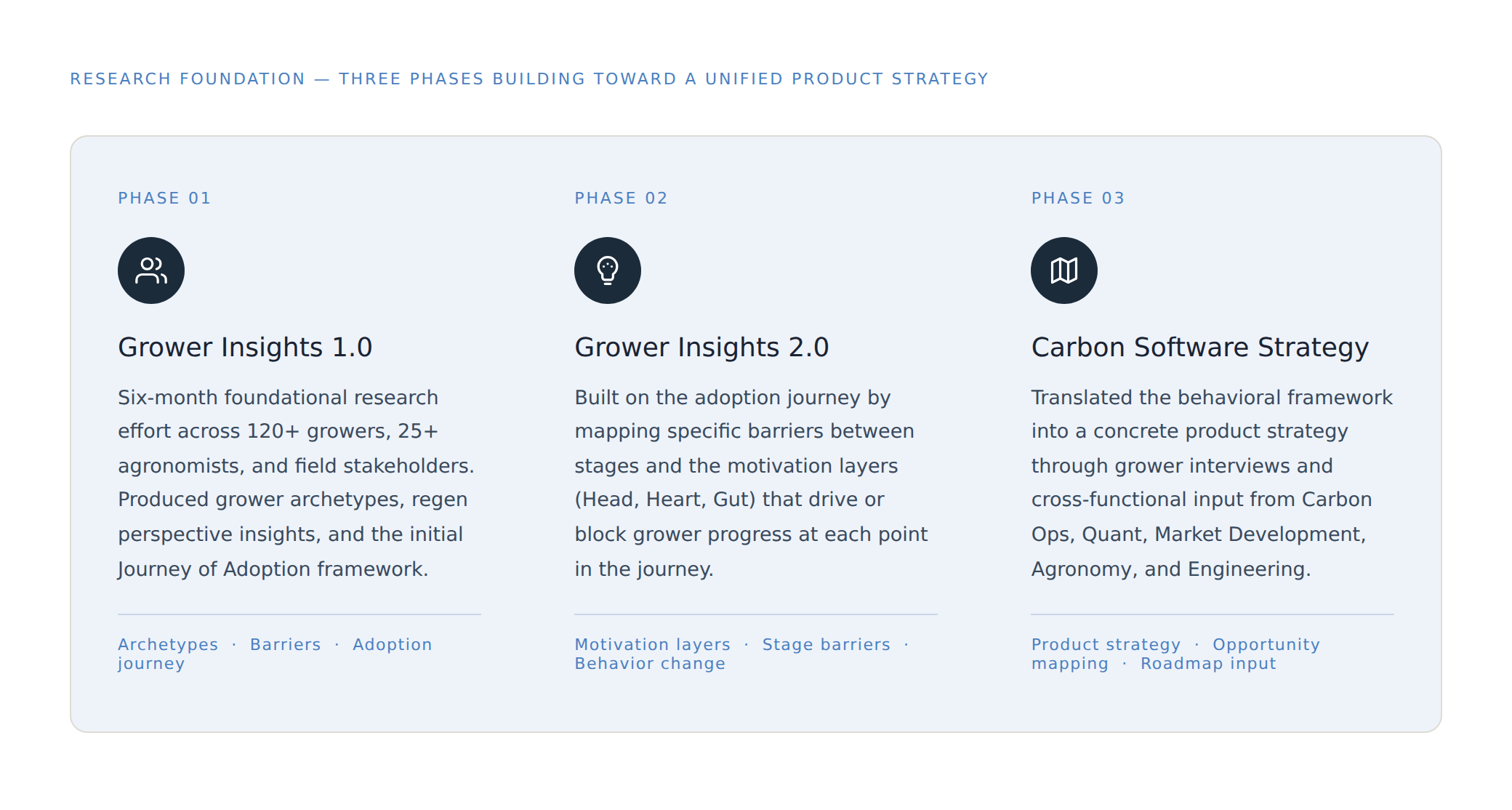
Across three phases of work spanning Grower Insights 1.0, Grower Insights 2.0, and the Carbon Software Strategy, I helped synthesize qualitative research across 120+ growers, agronomists, and cross-functional internal stakeholders into a practical strategic framework for how Indigo's carbon software should be designed. The result reframed carbon participation from a linear enrollment flow into a long-term grower journey requiring different kinds of support at every stage.
02 – RESEARCH FOUNDATION
Three phases of research building toward a unified product strategy.
This strategy was grounded in a substantial base of qualitative research conducted over roughly a year, synthesizing grower interviews, field ride-alongs, cross-functional internal interviews, and prior Carbon team efforts.
03 – THE CHALLENGE
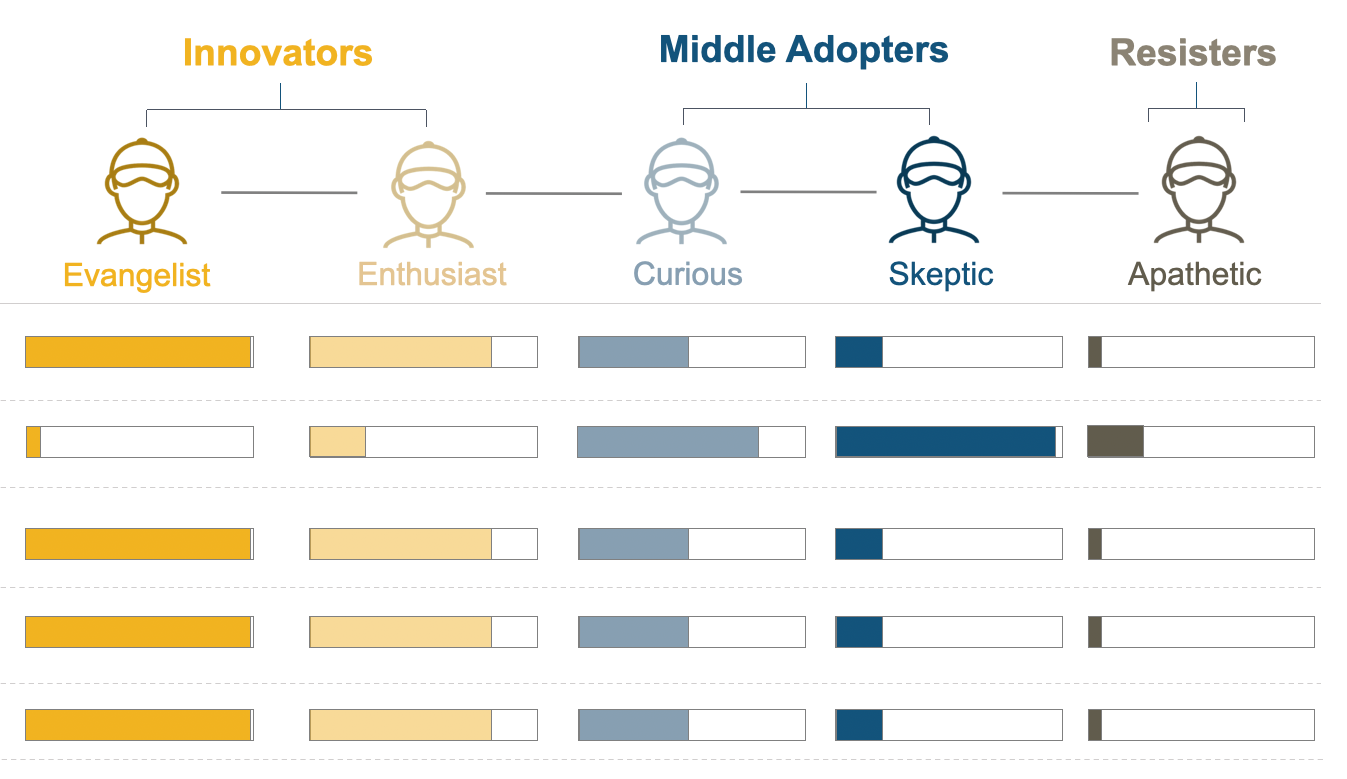
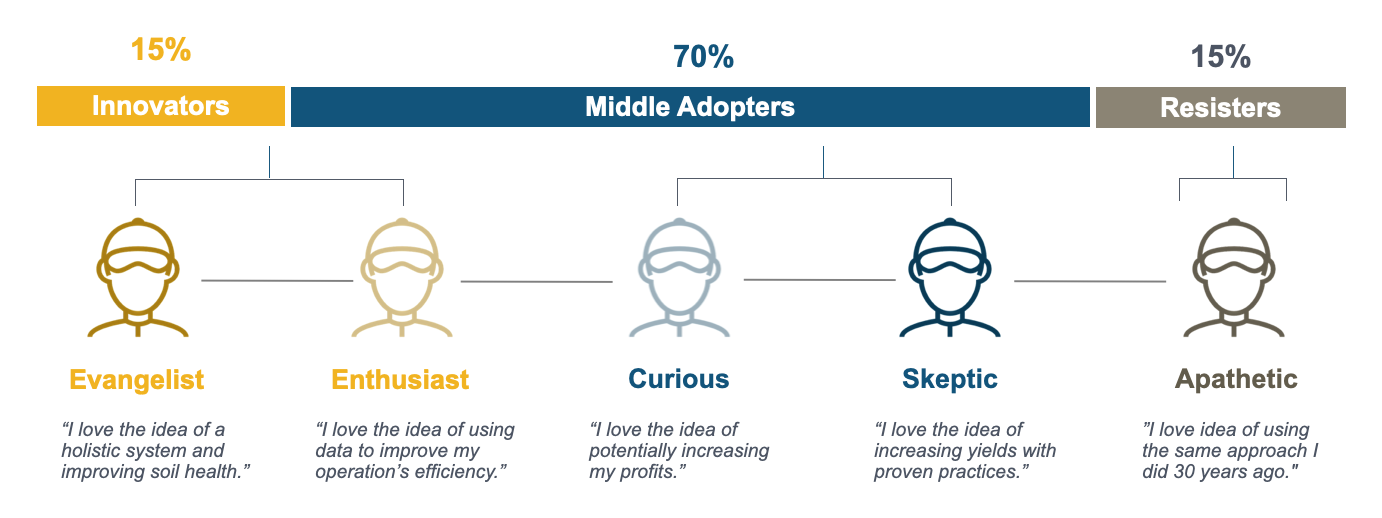
Growers weren't approaching carbon as a software workflow. They were evaluating it through the lens of risk, identity, and whether it fit their farm.
Many didn't trust Indigo yet. Many didn't believe regenerative practices would work in their context. Others saw carbon credits as confusing or unproven. Even interested growers often lacked confidence in how to start, plan, or manage the uncertainty of implementation.
The implication was significant: better screens alone wouldn't solve the problem. The product strategy had to support belief-building, confidence-building, and decision-making across the full grower journey.
04 – THE INSIGHT
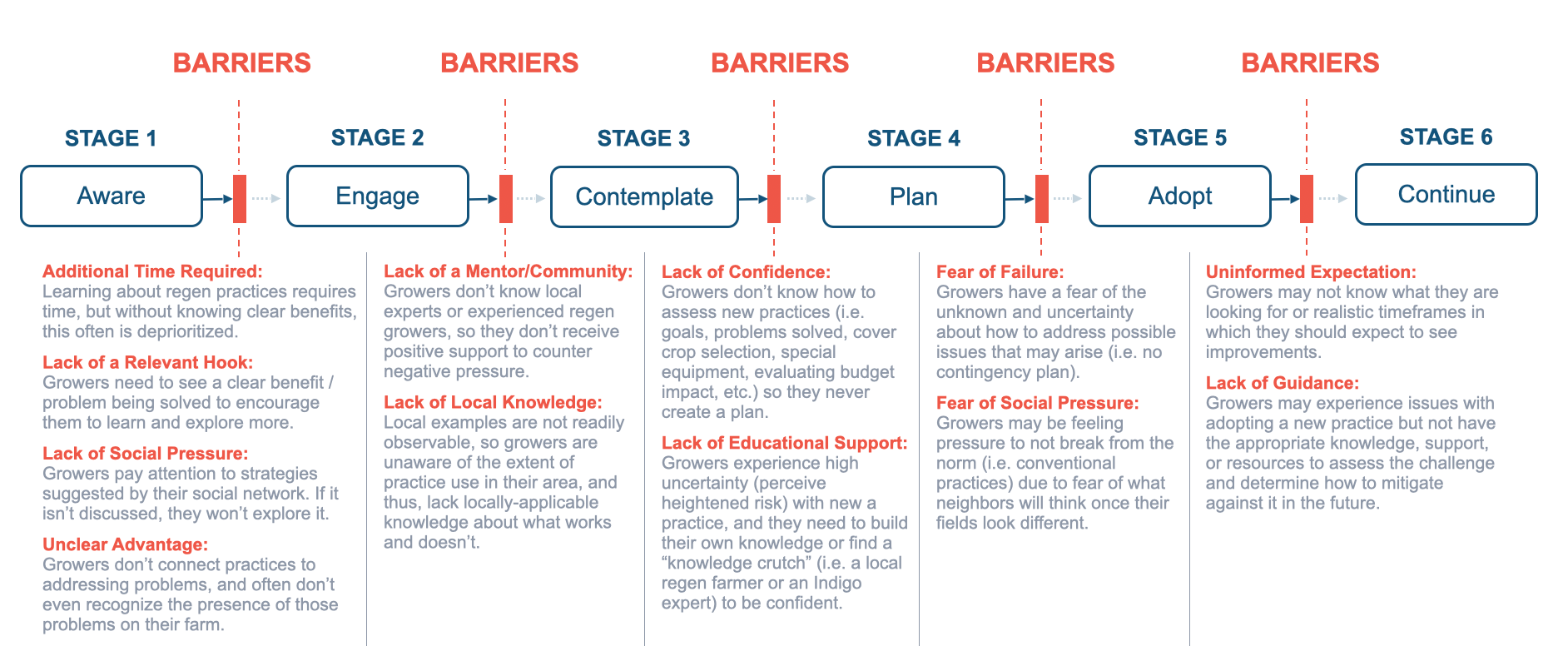
Growers don't adopt new practices because they were shown a feature or offered a payment. They adopt when they have enough trust, relevance, and confidence to believe a new path is both worthwhile and survivable.
That reframed the product question from "how do we get growers through enrollment?" to "what does software need to provide at each stage to help a grower move forward?" At different points, different things matter: early on, emotional friction dominates. Later, practical planning support becomes essential. Near adoption, identity and confidence matter more than information.
04 – THE FRAMEWORK
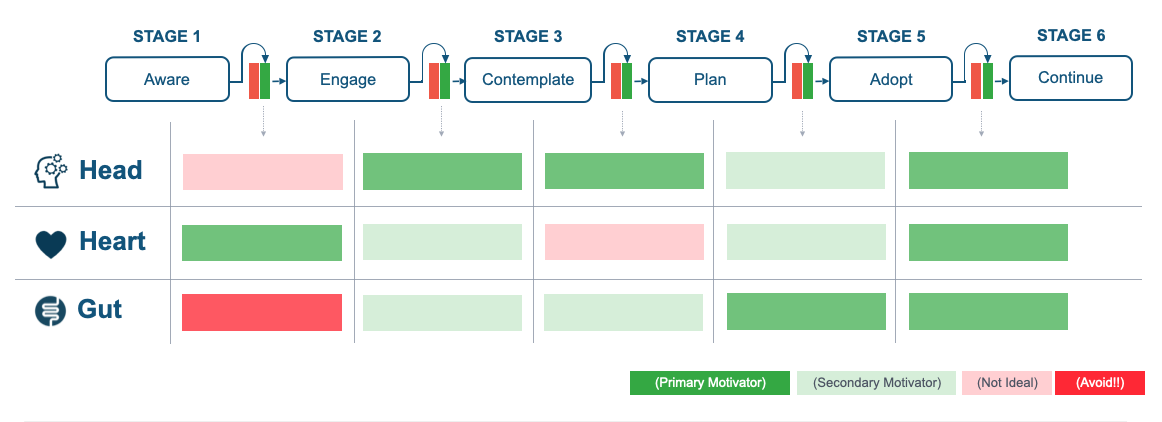
The motivation layers mapped to the adoption journey.
At each adoption stage, growers are driven by different primary motivations. Head (rational logic), Heart (emotional friction and trust), and Gut (identity and confidence) each dominate at different moments. The same message lands differently depending on where a grower is in the journey.
05 – THE SOLUTION
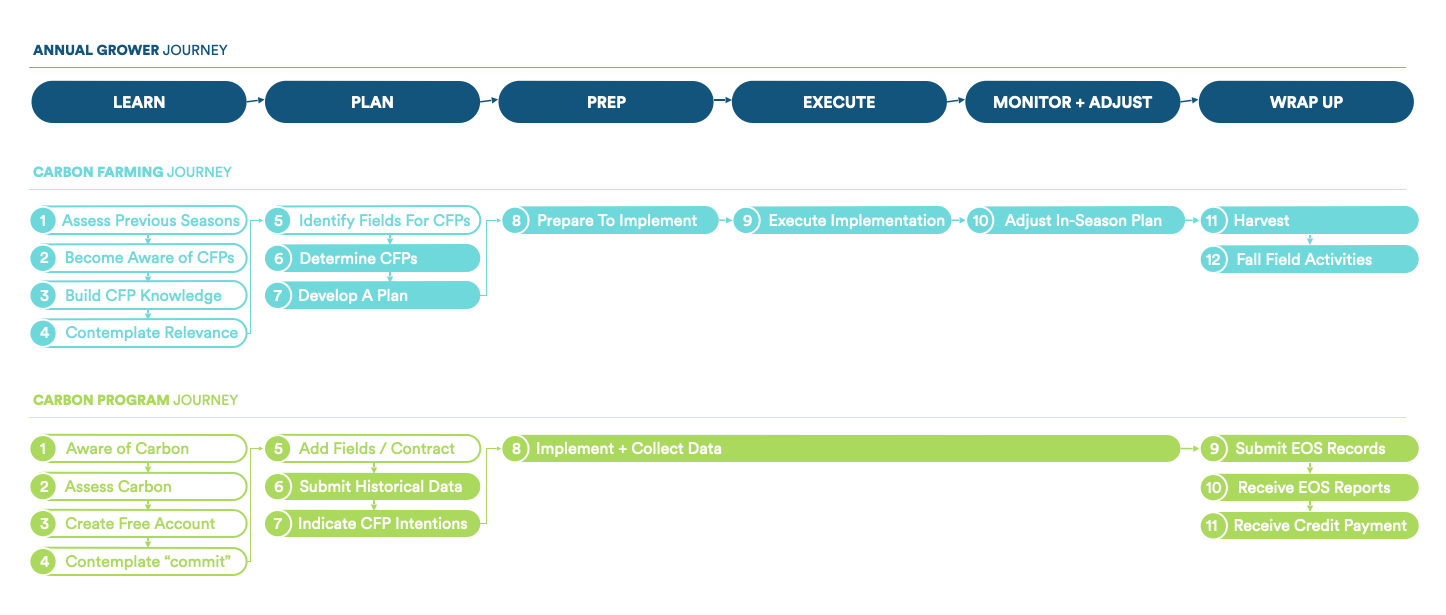
Three interacting journeys: annual, carbon farming, and carbon program.
Rather than imagining carbon software as a single product for form-filling and record submission, the strategy framed it as a system of supports that had to fit into the grower's real annual cycle.
The Carbon Software Strategy mapped the grower's annual journey across six phases (Learn, Plan, Prep, Execute, Monitor and Adjust, Wrap Up) and layered both the Carbon Farming Journey and Carbon Program Journey on top of it. Together, these created a realistic model of when growers are open to learning, when they need planning help, when they need execution support, and when they need proof of progress.
This changed both the "what" and the "when" of product thinking: different types of content, tools, nudges, and support depending on the season and the grower's adoption readiness.
05 – OPPORTUNITY MAP
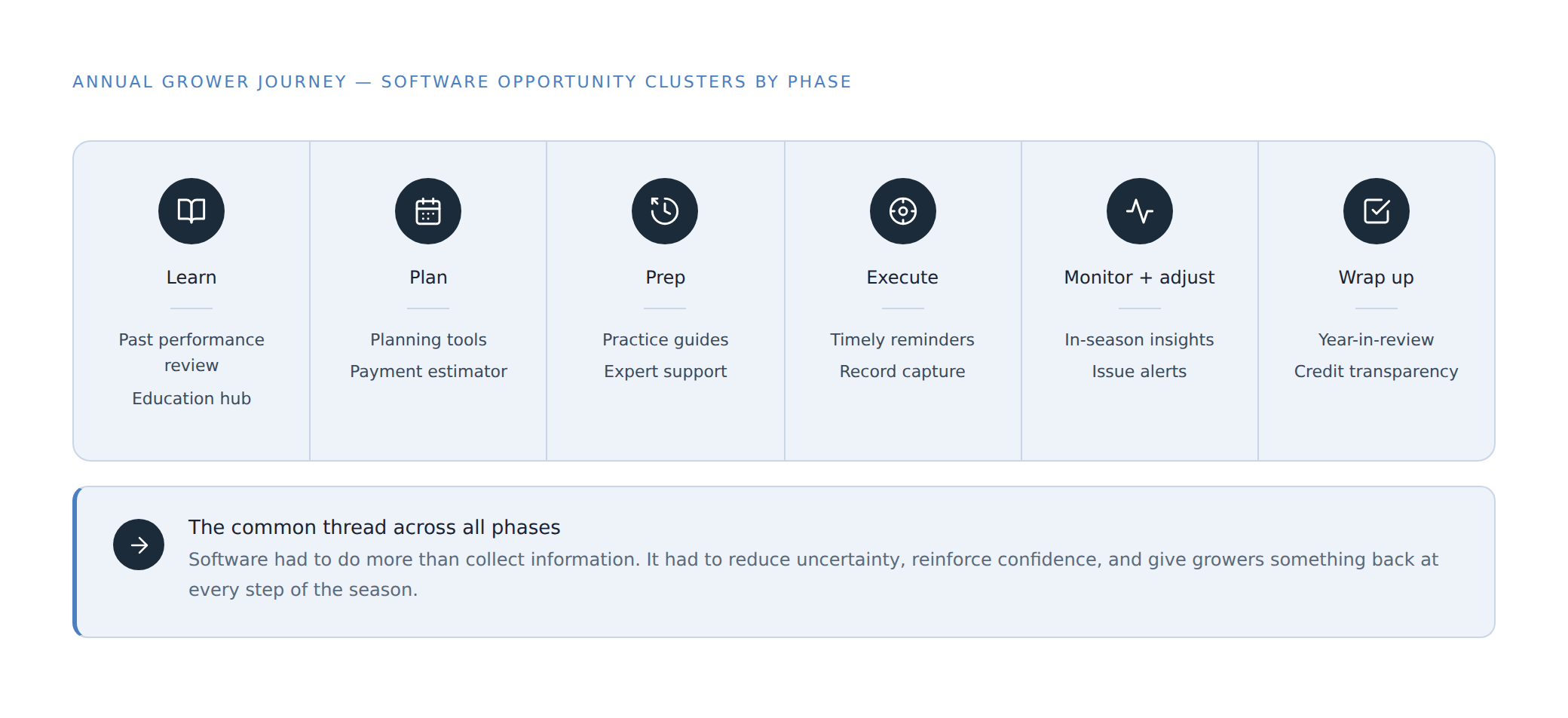
Software opportunity clusters across the annual cycle.
Each phase of the grower's year calls for a different kind of support. The strategy identified specific opportunity clusters per phase, giving teams a repeatable lens for evaluating future product concepts against real grower needs and seasonal timing.
06 – IMPACT
This work gave Indigo a shared strategic language for why growers hesitate and how product decisions should respond.
Informed product roadmap and concept development
The framework became a direct input to Carbon product prioritization, providing a principled basis for evaluating feature ideas against specific grower barriers and adoption stages.
Created a foundation for the product design work that followed
The research and strategic framing from this initiative directly informed the platform redesign work that came after, including the shift to crop-oriented program execution.
Shaped how the platform approached grower experience
The behavioral model and seasonal journey influenced how subsequent product teams designed grower-facing experiences across the platform, extending beyond the original software strategy scope.
Established cross-functional alignment on grower needs
By synthesizing perspectives across Product, Engineering, Agronomy, Ops, and Market Development, the strategy created a shared model that teams across disciplines could reference and build from.
06 – MY CONTRIBUTION
What I owned
Research planning and synthesis across 120+ growers, agronomists, and cross-functional stakeholders
Behavior-change framework and adoption journey modeling
Translation of research findings into product strategy and opportunity mapping
Per-phase software opportunity identification across the grower's annual cycle
Grower archetype development and barrier mapping
Motivation layer analysis across Head, Heart, and Gut dimensions
Three-journeys framework integrating Annual, Carbon Farming, and Carbon Program journeys
Cross-functional alignment and roadmap influence